
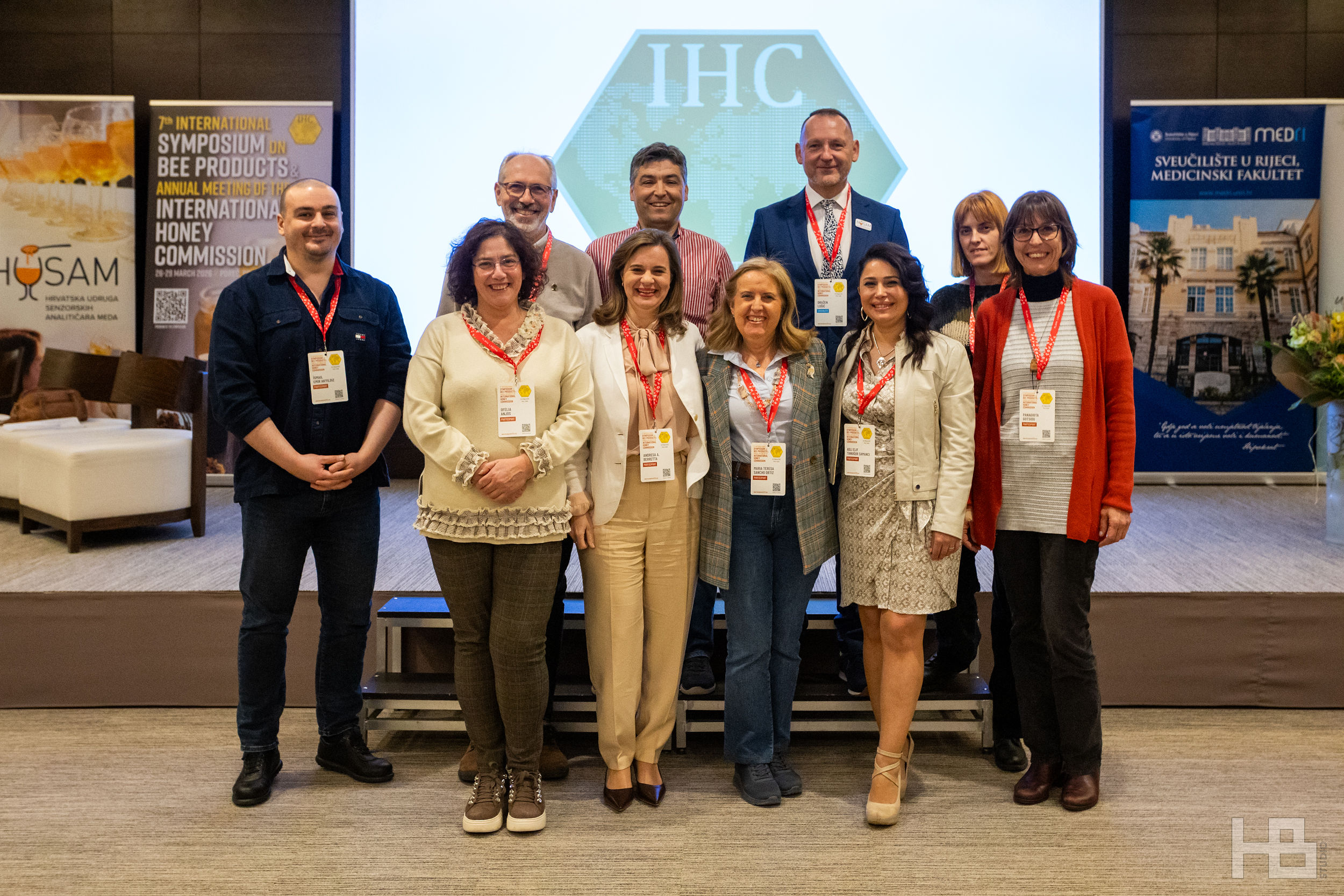
The 7th International Symposium on Bee Products, together with the Annual Meeting of the International Honey Commission (IHC), was held in Poreč, Croatia, from March 26–29, 2026. It gathered international experts in apicultural science, honey analytics, and regulatory policy. Overally, 180 people from 44 countries registered for the Symposium but the challenging situation in the Middle East prevented some of them to come.
Nonetheless, the organizers managed to carry out the scientific program as planned. It included keynote lectures, oral presentations and poster sessions displayed throughout the event to encourage continuous technical dialogue.

Opening ceremony was solemn and emotional. Among dignitaries and the institutional representatives and organizers the most emotional moment was performing of the children choir of the Elementary school “Poreč” from Poreč.


A major focus of the symposium was analytical method development for honey authentication, including isotope and NMR profiling, physicochemical markers, and botanical‑origin determination techniques. These areas align with long‑standing IHC efforts to harmonize global testing methodologies. The event also covered quality and bioactivity assessments for propolis, bee pollen, beeswax, and royal jelly, alongside studies addressing their potential use.


One of the central highlights was the panel discussion “Is Honey Fraud a Systemic Weakness or a Chosen Policy?” It was paneled by:
- Professor Emeritus Andreas Thrasyvolou (Aristotle University of Thessaloniki, Thessaloniki, Greece)
- Professor Miguel Vilas-Boas (Scientific Commission for Technology and Quality, Apimondia)
- Dr. Dario Lasić (Teaching Institute of Public Health “dr. Andrija Štampar”, Zagreb, Croatia)
- Dr. Nik Lupše (Scientific Committee on Safety and Quality of Bee Products, EBA)
- Professor Dražen Lušić (Faculty of Medicine of the University of Rijeka, Croatia and the President of the International Honey Commission)

Panelists emphasized that honey fraud persists largely due to uneven adoption of advanced analytical tools, inconsistent enforcement across countries, and regulatory fragmentation, which collectively allow adulterated products to infiltrate markets.
The IHC Annual Meeting continued its core mission of updating harmonized analytical standards foundational to the Codex Alimentarius Honey Standard and the EU Honey Directive. Ongoing discussions included improvements in authenticity testing, inter‑laboratory reproducibility, and standardization for non‑honey bee products. Overall, the 2026 symposium strengthened international cooperation, highlighting the need to integrate advanced analytical capability with robust regulatory frameworks to safeguard global honey integrity.


Workshops that were set up, brought attention to the previous work carried out by the Working Groups (WGs) of the International Honey Commission.


Last day was booked for a technical tour in Istria that provided participants with applied insights into regional production systems and unifloral characteristics.


And last but not the least, in tight bidding for the hosting of the next IHC Symposium, between Istanbul (Turkey) and Chania (Greece), the decision was taken – The next IHC Symposium of 2028 is going to be held in Greece! It will be hosted by Mediterranean Agronomic Institute of Chania CIHEAM Chania. Looking forward to meet again in Greece 2028.


How it looked through the lenses of the photo-camera (by HB-Studio), you can check on the following links:
Digital photo studio (Integral)
Day 1, Day 2, Day3, Day 4
